Japanese Walking: What the Original Study Actually Tested
The viral timer gets the 3-minute rhythm right, but timing was only one part of the Japanese trial. We checked the primary study, separated its measured protocol from social-media shortcuts, and built a free timer plus a private log for your own walks.
Start the Japanese walking timer
The default reproduces the study's timing pattern—not its laboratory-tested intensity. Audio and vibration cues are optional.
Easy walk
03:00
Cycle 1 of 5
Timer ready. Begin with an easy walk.
Elapsed
00:00
Remaining
30:00
Total
30:00
How to follow each phase
Easy means a comfortable, conversational pace. Brisk means purposeful walking that raises your breathing while remaining controlled. The default five 3:3 cycles make a 30-minute session.
Part of our cardio & walking calculators hub—explore connected tools and practical guidance.
The detail most summaries miss
The study tested intensity; the viral version mostly tracks time
A phone can tell you when three minutes are over. It cannot know your peak aerobic capacity, which the researchers measured individually before prescribing the easy and fast phases. That makes this timer useful for structure, but not a laboratory-equivalent reproduction of the trial.
| Detail | 2007 randomized trial | This free timer | Why it matters |
|---|---|---|---|
| Intervals | 3 minutes low + 3 minutes high | 3 minutes easy + 3 minutes brisk | The clock pattern matches. |
| Intensity | 40% then above 70% of tested peak walking capacity | Talk-test cues only | A generic pace or heart-rate percentage is not the original prescription. |
| Dose | 5+ sets a day, 4+ days a week, for 5 months | 5 sets by default; fully adjustable | One 30-minute walk cannot reproduce a five-month intervention. |
| Monitoring | Accelerometry plus pre/post fitness testing | Browser timer; optional self-entered log | The timer does not measure fitness change or verify intensity. |
246
Adults randomized across three groups
63 ± 6
Mean age in years
5 months
Length of the intervention
42 of 87
Interval-group participants who met the training target
The adherence number changes the story
Only 42 of the 87 people assigned to interval walking met the study's training target. The paper still reported meaningful group improvements, but this detail is a reminder that a memorable protocol and a sustainable habit are not the same thing.
How to do Japanese interval walking
Start easy
Use the first three minutes to settle into a comfortable rhythm. You should be able to speak normally.
Switch to brisk
Lengthen your posture and move your arms. Breathing should rise, but your stride must remain controlled.
Repeat five times
Alternate both phases for five cycles. Add an easy warm-up and cool-down if you need them.
Easy versus brisk: use effort, not a magic speed
The original study set intensity from each participant's tested aerobic capacity. A universal treadmill speed cannot reproduce that prescription, so use the talk test and your own effort as practical field guides.
| Phase | Talk test | Effort cue | Form cue |
|---|---|---|---|
| Easy | Full sentences feel comfortable | Light and sustainable | Relax shoulders and recover |
| Brisk | Short sentences; no gasping | Challenging but controlled | Tall posture and active arms |
What the trial found—and what it cannot prove for you
In the interval group, the researchers reported increases of 13% in isometric knee extension, 17% in knee flexion, 8% in peak aerobic capacity measured by cycling and 9% in peak aerobic capacity measured by walking. These changes were significantly greater than those seen in the moderate continuous-walking group; the interval group also had a larger reduction in resting systolic blood pressure.
Those are five-month group results from middle-aged and older Japanese adults—not promises for every age, condition or 30-minute session. The abstract does not report weight-loss results, and the timer cannot test your aerobic capacity. A 2024 scientific review concluded that interval walking can improve fitness and muscle strength, while also calling long-term adherence a challenge and asking for more real-world research on hard health outcomes.
Research sources
- Nemoto et al., Mayo Clinic Proceedings (2007) — the foundational five-month interval-walking trial.
- Karstoft et al., scientific review (2024) — a broader assessment of benefits, mechanisms, adherence and evidence gaps.
- Nose et al., field-research overview (2009) — explains how the research team implemented and monitored the interval protocol.
Original utility: compare, don't guess
Run a transparent 14-day comparison on your own device
Log three ordinary 30-minute walks first, then record interval sessions on a similar route and at a similar time where practical. Compare distance, heart rate and perceived effort—not weight loss or long-term fitness, which a short personal test cannot establish. Weather, heat, humidity, air quality, hills and wearable error can all change the numbers.
Regular walk baseline
0 logged- Avg distance
- —
- Avg HR
- —
- Avg effort
- —
Japanese interval walk
0 logged- Avg distance
- —
- Avg HR
- —
- Avg effort
- —
This is an N-of-1 activity log, not a clinical test. Its purpose is to make your comparison reproducible and honest; it cannot diagnose a condition or prove that the method caused a change.
Stop signs matter
Stop and seek appropriate help for chest pain, faintness, unusual breathlessness, a racing or irregular heartbeat, or sharp joint pain. Do not use a viral workout as a reason to push through warning symptoms.
If you have a known heart, lung, balance or mobility condition, ask your clinician how to adapt the brisk phase before starting.
India-specific conditions can distort your comparison
Heat and humidity can raise cardiovascular strain at the same walking pace. Poor air quality, monsoon surfaces and heavy traffic can also make a brisk interval inappropriate or unsafe.
Record the conditions in the log, choose a safe route or indoor option, and do not chase matching heart-rate numbers when the environment changes.
Why an older protocol has a new viral name
A fitness-industry report ranked “Japanese walking” as its fastest-growing 2026 workout term, based on a 2,968% increase in worldwide Google Keyword Planner search volume from July–September 2024 to the same months in 2025. That commercial report is evidence of attention—not health effectiveness—which is why this page separates the current search story from the older research. Read the report and methodology.
How this page was made—and its limits
Sources:We extracted the participant numbers, prescribed intensities, adherence counts and reported outcomes from the PubMed record for the 2007 randomized trial, then checked the interpretation against the research team's open-access field overview and a 2024 scientific review.
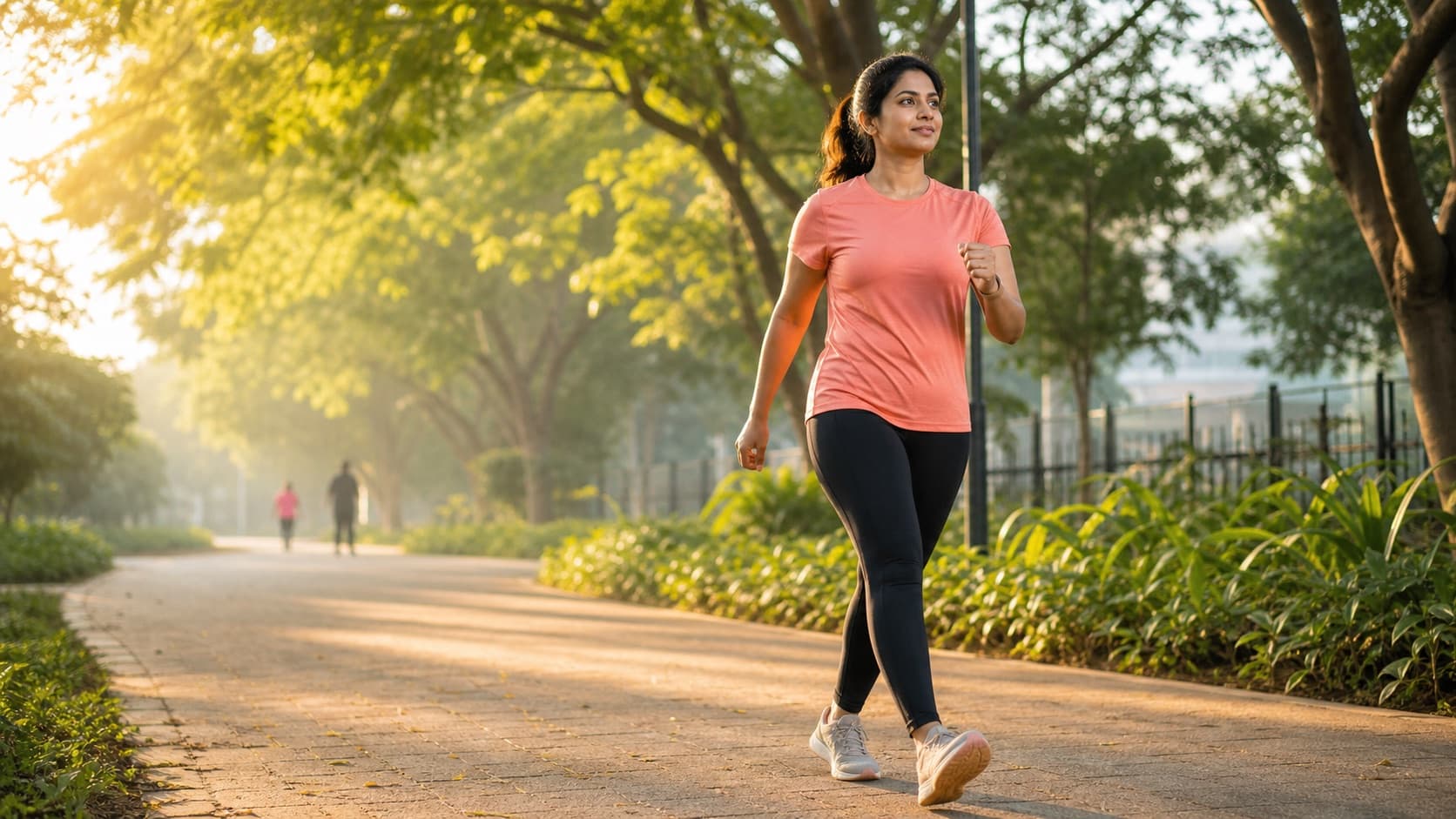
Automation disclosure: AI assisted source discovery, drafting and software development. Every numeric research claim shown above was checked against the cited primary record. The hero is an AI-generated illustration and is labelled as such; no synthetic image is presented as documentary evidence.
What is missing: This version does not claim a first-person trial, publish invented wearable results or imply an expert interview. It has not been medically reviewed by a clinician. The page will only add those signals if real measurements, original photos and a qualified reviewer can be documented.
Found a mismatch with a cited paper? Email support@asterisks.app with the URL and source so we can investigate it.
Related Fitness Calculators

Walking Pace Calculator
Calculate walking pace, speed, and stride length based on distance, time, and step count.

Walking Calorie Calculator
Estimate calories burned walking based on speed, weight and incline.

Steps to Distance Calculator
Convert your daily step count to walking distance in km or miles.

Heart Rate Zone Calculator
Find your 5 heart rate training zones for fat burn, aerobic and max effort.

Race Time Predictor
Estimate race finish times and target paces from 5K to Marathon using Riegel's formula.

Running Split Calculator
Generate kilometer or mile pacing splits for target race times with customizable pacing models.

Treadmill Pace Converter
Convert between treadmill speeds (mph, km/h) and outdoor running paces (min/km, min/mile).

Treadmill Incline Calculator
Calculate equivalent flat pace, elevation gain, and effort multiplier of running on a treadmill incline.
Looking for a broader plan? Browse all cardio & walking calculators →